
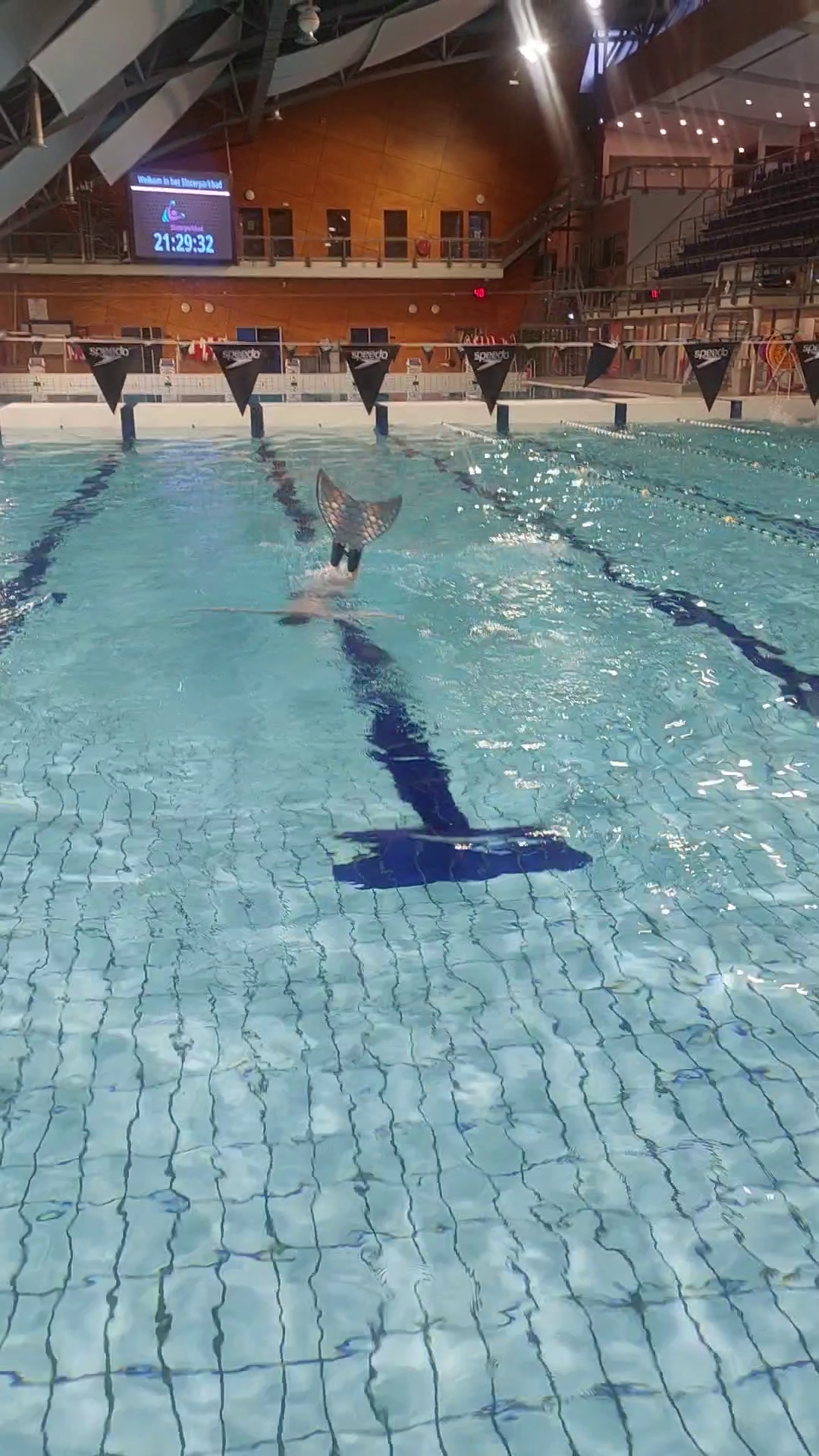
During the summer, I was able to do some mermaiding for half an hour at the end of Friday training at my swim club. At the initiative of the competitive swimmers, the Friday training had been extended by thirty minutes. With a 90-minute session, they could better prepare for competitions.
At first, I didn’t realize it was only two lanes that were being used. Most club members left the pool after the regular hour, and the lane lines were taken out of the water. That left me with half a pool to swim in. I asked the trainer each time – since they rotate – whether I could stay the last half hour to do mermaiding, and they all agreed.
A few members gave me odd looks, a few thought it was fun and showed interest, and most just seemed fine with it or said nothing at all. I didn’t mind the occasional strange look. I was mainly just thrilled to finally be able to practice my hobby in the Netherlands.
And it was so good. In that half hour, I felt as free as a fish in the water. I could swim in all directions, spin on my axis, do somersaults, and make big splashes with my tail. It was fintastic! Before each session, I would study YouTube tutorials and then practice what I’d learned in the pool.
Unfortunately, after the summer, the club decided in a members’ meeting not to continue the extra half hour. The reason: the additional cost for the club, and the fact that only a few members made use of it.
I tried to save the idea by suggesting we limit it to just the three months leading up to the busiest competition season. That would reduce the cost to €500 instead of €2,000.
Not everyone understood that I saw the proposal as broader than just my own interest. I actually saw it as a win-win situation: more visibility and space for both competitive swimming and mermaiding. Both could help the club attract new members – each in their own way.
It was a pity that so few competitive swimmers were present that evening. As a result, my argument may have come across as too personal, even though I meant it in a broader sense.
Unfortunately, I wasn’t able to steer the conversation back to the original idea: improving the competitive training schedule.
But just because it didn’t work out now, doesn’t mean it never will. Like so many things, change takes time. And I still believe it will happen.